
NLP How we create our experience
Introduction
Each blog is written as a complete part that can stand on its own. Because of this, you will find that some concepts will be repeated.
NLP 1 How we create our experience
NLP 2 The structure of experience
NLP 3 Understanding the three core elements of NLP
NLP 4 Your inner map
NLP 5 Why we repeat patterns and how awareness opens the possibility for change
NLP 6 The three minds
NLP 1 How we create our experience
What we experience is not simply what happens around us, but how we interpret, filter, and give meaning to it.
Every situation is processed through our senses, shaped by our past experiences, influenced by our beliefs, and organised through language.
Over time, this creates patterns.
Patterns of thinking.
Patterns of feeling.
Patterns of behaviour.
And while these patterns can be helpful, they can also become limiting especially when they operate outside of our awareness.
Understanding how we experience and shape our reality
At its essence, Neuro-Linguistic Programming (NLP) is a model of understanding how we experience the world.
It offers a practical framework for exploring how our thoughts, language and patterns of behaviour influence the way we live, relate, and respond.
What does NLP stand for?
The name Neuro-Linguistic Programming reflects three interconnected aspects of human experience:
Neuro
How we process experience through our senses, what we see, hear, and feel.
Linguistic The language we use, both internally in our thoughts and externally in communication with others.
Programming
The patterns we develop over time: ways of thinking, responding and behaving that, through repetition, become familiar and shape how we experience and respond to life.
Together, these form the structure, which operates as a filter through which we experience life.
NLP helps us become aware of this structure so that we are no longer unconsciously driven by it.
Your inner map of the world
One of the central ideas in NLP is that each of us lives in our own “map of the world.”
This map is shaped by many influences:
childhood experiences
beliefs and values
culture and environment
education and relationships
personal successes and setbacks
This map helps us navigate life.
But this is not reality itself: it's an interpretations of it.
As Alfred Korzybski expressed:
“The map is not the territory.”
The way we see a situation is not the only way it can be seen.
And when this becomes visible, something begins to shift.
Why we repeat patterns
Many people come to coaching with a sense that they are capable of more, yet find themselves repeating familiar reactions.
Perhaps certain situations trigger the same response again and again.
You may notice stress, doubt, or hesitation even when you would prefer to respond differently.
Often, this is not a lack of effort.
It is a reflection of patterns that have been learned over time.
Patterns that once served a purpose perhaps offering protection, stability, or direction — but that may no longer support the life you want to live.
NLP does not approach these patterns with judgment.
Instead, it approaches them with curiosity.
Because when we begin to understand how a pattern is created, we also begin to see how it can be changed.
From awareness to choice
At the heart of NLP is a simple but powerful shift:
From being inside our experience
to becoming aware of how that experience is being created.
This shift creates space.
And within that space, something becomes possible: choice
Not forced change.
Not pressure.
But the ability to respond differently because we begin to see differently.
A different way of understanding change
Perhaps one of the most important insights within NLP is this:
Change does not begin by trying harder.
It begins by seeing differently.
By understanding how your experience is created.
By noticing the patterns that shape it.
And by allowing space for something new to emerge.
If something in this resonates, you are welcome to explore it further in a coaching conversation.
NLP 2 The structure of experience
We often think that our experience is a direct result of what happens around us.
A situation occurs and we respond.
Simple.
And yet, when we begin to look more closely, something else becomes visible.
Between what happens and how we respond, there is a structured process.
The structure of experience in NLP refers to how you internally construct reality. Rather then responding directly to the external world, we create internal representations in the form of images, souds, feelings and the qualities of these representations (such as brightness or intensity) determine how strongly we experience them. These representations generate our emotional and physiological state which in turn influences our behaviour and respons. At another level this process is influenced by our beliefs, values and sense of self.
Experience is not immediate
So, what we experience is not simply the event itself.
It is the result of how that event is perceived, filtered, and interpreted.
In a single moment, we take in information through our senses.
We notice certain things and not others.
We give meaning to what we perceive.
And from that meaning, a feeling and a response emerge.
This happens so quickly, that it can feel as though our reaction is the only possible one.
But it is not.
A simple way to understand the structure
In NLP, this process is sometimes described in a simple way:
Experience → Language → Response
We encounter something.
We interpret it often through language, belief, and memory.
And from that interpretation, we respond.
As our response is not only shaped by what happens, but also by how we interpret it, there is also space for change.
The role of language and meaning
Much of this process is shaped through language.
Not only the words we speak to others,
but the words we use internally often without noticing.
The way we describe a situation can intensify it, soften it, or transform it entirely.
A moment becomes a problem.
A challenge becomes a failure.
An uncertainty becomes something to fear.
And once meaning is assigned, our experience begins to follow.
This is why, in NLP, language is not seen as separate from experience
but as something that actively shapes it.
The present moment: where awareness enters
Although this process is constant, it usually remains invisible.
We move through it automatically.
Until something interrupts it.
A pause.
A question.
A moment of awareness.
In NLP, the present moment is where this interruption becomes possible.
Because when attention returns to what is happening right now, we begin to notice:
What am I experiencing?
What meaning am I giving this?
What is happening in my thoughts, my body, my response?
This is the moment where we step out of being fully identified with the experience
and begin to observe it.
And in that observation, you will experience space.
From reaction to choice
In everyday life, it can often feel as though we are reacting automatically.
And in many ways, we are.
Patterns repeat.
Interpretations happen instantly.
Responses follow without much reflection.
But when we begin to see the structure of this process, something shifts.
We are no longer only inside the experience.
We begin to see how it is being created.
And this is where choice becomes available.
Not because we force ourselves to change,
but because we begin to see that there are other ways of interpreting and responding.
Why this matters
Understanding the structure of experience changes how we relate to ourselves and to life.
It softens the idea that we are “stuck” in a certain way of being.
It opens the possibility that what we feel and how we respond is not fixed
but shaped through processes that can be understood.
And when something can be understood,
it can begin to shift.
The role of NLP in this process
NLP offers practical ways to explore this structure more consciously.
It brings attention to:
how we filter and interpret experience
the language we use internally and externally
the patterns that shape our responses
and the states from which we think and act
By making these processes visible, NLP does not try to control experience.
It allows us to relate to it differently.
With more awareness.
More space.
And often, more flexibility.
A gentle reflection
You might take a moment to notice:
What is something you are currently experiencing in your life?
And as you consider it:
What meaning are you giving it?
What words are you using to describe it?
And how might your experience shift if that meaning changed, even slightly?
Sometimes, the smallest shift in perception
can open the door to a completely different experience.
If something in this resonates, you are welcome to explore it further in a coaching conversation.
NLP 3 Understanding the three core elements of NLP
It’s a model of understanding how our experience is organized and how we can change it.
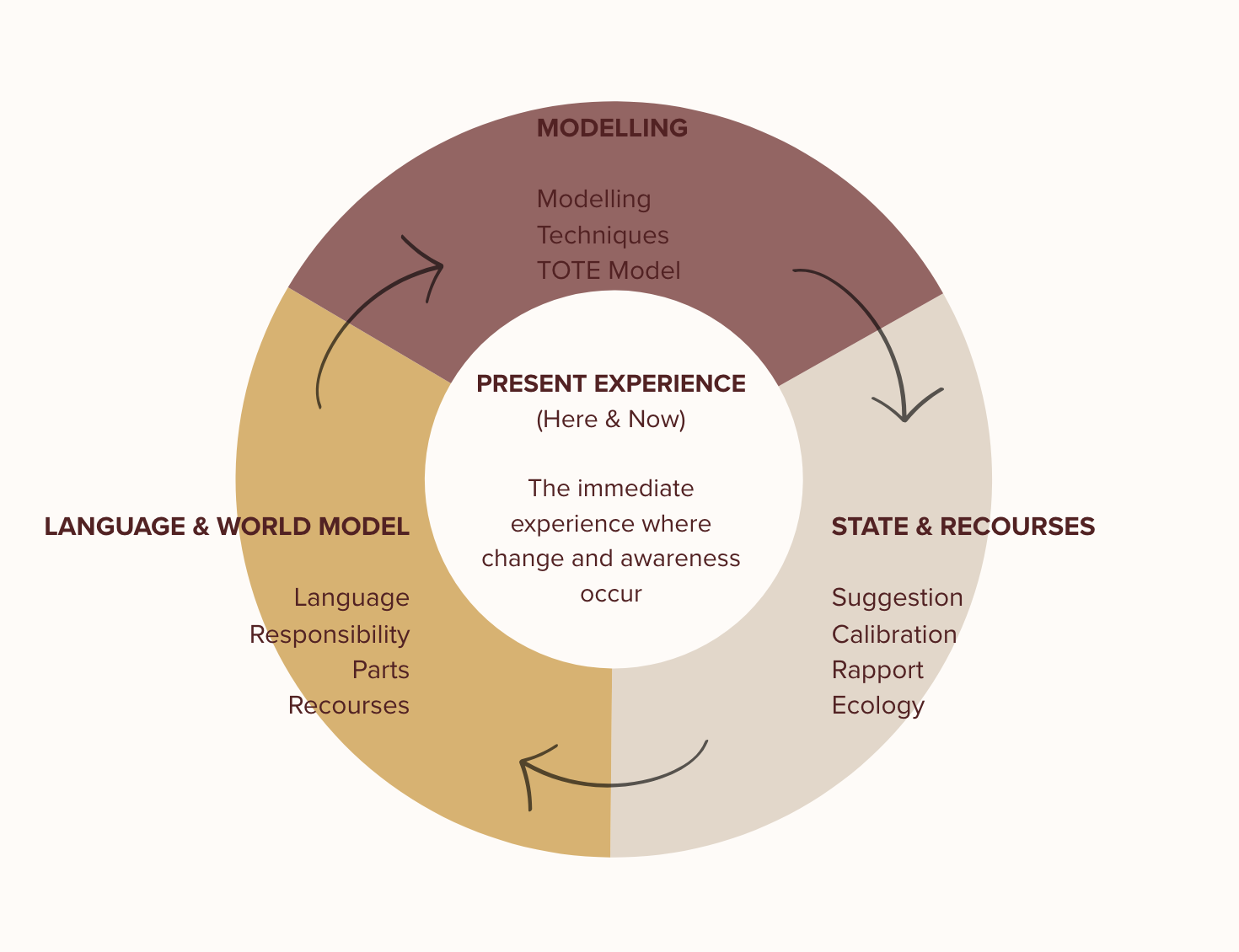
The illustration shows how key elements of NLP in three interconnected areas, all centred around one essential point: present experience.
The Centre: Present Experience
This is where life is actually happening.
Not in the past.
Not in the future.
In what you are thinking, feeling, sensing and noticing right now.
This is also where awareness begins.
And where change becomes possible.
Because when we are fully inside an experience, we tend to react automatically.
But when we begin to notice that experience as it unfolds, something shifts.
A small space appears.
And within that space, there is the possibility of choice.
Modelling
Modelling focusses on how people become succesful in what they do.
It’s a way of analysing all the aspects involved that leads to succesful outcomes.
language & meaning
beliefs
state & emotions
perception (your inner map)
behaviour
resources
relationship & rapport
awareness
There are three aspects in the modelling process:
modelling behaviour and thinking patterns
practical techniques
the TOTE model, which describes how we move toward outcomes through feedback and adjustment
Modelling asks the questions: Not only: what is not working?
But also: what works and how does it work?
By understanding the structures of effective behaviour, new possibilities become possible.
Language & world model
A second area relates to how we interpret and give meaning to our experience.
Each of us moves through the world with an internal model shaped by our history, beliefs, and the language that we use.
This includes:
language and meaning
responsibility - recognising our role in how we interpret experience
parts - the different inner voices or aspects within us
resources - the capacities and strengths we can draw upon
We do not respond to reality directly.
We act in accordance with the meaning we give to our preceived reality.
And when that meaning shifts, our experience can shift with it.
State & resources
The third area focuses on our state: the emotional, physical and relational conditions we are in.
Our state influences how we think, feel and respond.
This part of the model includes:
suggestion - how language influences attention and experience
calibrating non - verbal signals - noticing subtle cues in ourselves and others
rapport and connection - the quality of relationship
ecology - the wider impact of change
This reminds us that we do not experience life in isolation.
We are always in relationship with ourselves, with others, and with our environment.
Three Areas, One Living Process
Although these areas are shown separately, they are always interacting.
Our state influences how we interpret situations.
Our language shapes what we notice.
Our patterns determine how we respond.
And at the centre of all of it is present experience.
This is where awareness enters.
This is where we begin to observe rather than react.
And this is where something new can emerge.
A Gentle Reflection
You might take a moment to notice:
Which part of this model feels most present in your life right now?
Is it the patterns you repeat?
The way you interpret situations?
Or the state you bring into your experiences and relationships?
Simply noticing this is often where change begins.
If something in this resonates, you are welcome to explore it further in a coaching conversation.
NLP 4 Your inner map
We often move through life as though we are responding to reality as it is.
A situation happens.
We interpret it.
We feel something.
We respond.
It seems immediate. Direct. Self-evident.
And yet, when we begin to look more closely, something subtle becomes visible:
We are not responding to reality itself
but to our interpretation of it.
The map we live in
Each of us carries an internal map of the world.
A way of organising what we see, hear, and experience.
A way of making sense of what happens around us.
This map is shaped over time:
Through childhood experiences.
Through culture, language, and environment.
Through relationships, education, and personal history.
It is influenced by what we have learned to notice
and what we have learned to ignore.
The more awareness we have of our internal map the more choices we have in how to respond.
The map is not the territory
This idea was expressed clearly by Alfred Korzybski:
“The map is not the territory.”
What we experience is not the world as it is
but the world as it appears through our filters.
We distort information.
We delete information.
We generalise information.
And in doing so, we create a version of reality that is meaningful to us
but not necessarily complete.
It is how human perception works.
The role of language
Language plays a central role in shaping this map.
Not only in how we communicate with others,
but in how we interpret and structure our inner experience.
The words we use often unconsciously also give meaning to what we experience.
The language influences:
what we notice
what we emphasise
what we assume
and what we believe is possible
A situation described as overwhelming is experienced differently from one described as challenging.
A conversation framed as conflict feels different from one framed as misunderstanding.
Meaning is not fixed
Because language shapes meaning,
meaning itself is not fixed.
It is constructed.
Often quickly. Often automatically.
And often without being questioned.
We assign intentions.
We draw conclusions.
We tell ourselves stories about what something means.
And once that meaning is in place,
our emotional response follows.
Yet what becomes visible through NLP is this: meaning can shift.
And when meaning shifts, experience shifts with it.
The filters we don’t see
Much of this process happens outside of awareness.
We filter information constantly:
We generalise
We delete details
We distort certain aspects of experience
These filters help us navigate a complex world.
But they can also narrow our perspective.
We may assume something is always a certain way.
We may overlook alternative interpretations.
We may respond to a situation based on an old pattern rather than what is actually present.
And because this happens so quickly, it feels like “the truth.”
From one perspective to different perspectives
When we begin to recognise that our map is only one possible interpretation, something softens.
We are no longer locked into a single way of seeing.
Instead, a question becomes available:
What else could this mean?
This question is simple, yet powerful.
Because it opens the possibility that:
another perspective exists
another response is available
another experience is possible
Not by denying reality
but by expanding how we relate to it.
A living and changing map
Your inner map is not fixed.
It is continuously shaped by what you notice, how you interpret, and the language you use.
And just as it has been formed over time, it can also evolve.
Through awareness.
Through reflection.
Through exercises we create new experiences and new perspectives.
A gentle reflection
You might take a moment to notice:
Is there a situation in your life that feels fixed or defined in a certain way?
And if you pause:
What meaning did you give the situation?
What language are you using to describe the situation?
And what becomes possible if that meaning softens, even slightly?
A shift in perspective does not change the situation itself.
But it can completely change how you experience it.
If something in this resonates, you are welcome to explore it further in a coaching conversation.
NLP 5 Why we repeat patterns and how awareness opens the possibility for change
Many people have a sense that more is possible in life,
yet find themselves stuck repeating familiar patterns.
A reaction that comes back in certain situations.
A way of thinking that returns under pressure.
A dynamic in relationships that seems to play out again and again.
Even when there is a clear intention to respond differently,
something continues to pull us back into what is known.
This can feel frustrating and limiting.
Yet from the perspective of NLP, these patterns are not random.
They have structure.
And they have a history.
Patterns are learned, not fixed
What we experience as a pattern is something that has been learned over time.
A way of responding that originally made sense in that specific situation or specific situations.
It probably was a way to survive and the best way to cope with a strenuous, dangerous or painful situation.
How patterns become automatic
Over time, this response becomes familiar.
And what is familiar becomes an automatic respons
A situation arises.
We recognise it, often unconsciously as something we have encountered before.
A meaning is assigned.
A feeling follows.
And then a response.
Familiar does not always mean supportive
Patterns became familiar because they worked in the past.
A belief that once protected you may now limit you.
A behaviour that once helped you cope may now create tension.
A way of thinking that once gave clarity may now narrow your perspective.
The pattern continues, not because it is the best option,
but because it is the most practised one.
The role of meaning
At the centre of many patterns lies meaning.
Not the situation itself,
but the meaning we give to it.
A comment can feel like a criticism.
A silence can be understood as a rejection.
A challenge with a different outcome can be peceived as a failure.
Once there is a meaning an emotional and behavioural response follows.
And because this meaning often feels immediate and true,
we rarely pauze and question it.
Yet this is where change is possible.
From identification to awareness
A key shift in NLP is the movement from being fully inside a pattern
to becoming aware of it.
Instead of: “I am this way” something else becomes possible:
“This is a pattern I am experiencing”
Because the moment we can observe a pattern,
we are no longer completely identified with it.
And in that space, something opens.
Awareness creates space
When awareness enters, the pattern does not immediately disappear.
We notice the moment the pattern starts.
We recognise the familiar thoughts.
We become aware of the feeling that comes with it.
And instead of being carried away into the same response,
there is a pause. Even a brief one.
And in that pause, something becomes available: a different way of responding.
Change does not require effort but empathy
We can’t force the change but we can invite it gently and mindfully.
In this space you will start to relax and open up to new insights and behaviors.
So be gentle with yourself, appreciate what has served you for such a long time and be curious to what else is possible.
In other words become your own best friend.
A gentle reflection
You might take a moment to notice:
Is there a pattern in your life that feels familiar?
And if you look at it with curiosity:
When does it tend to appear?
What meaning are you giving the situation in that moment?
And what happens if you simply observe it without trying to change it right away?
Sometimes, the act of noticing
is already the beginning of change.
If something in this resonates, you are welcome to explore it further in a coaching conversation.
NLP 6 The three minds
Thinking, body and field mind in coaching
When we try to understand ourselves, we often begin with thought.
We reflect.
We analyse.
We try to make sense of what is happening.
And while this can bring clarity,
it is only part of the picture.
Because we are not only thinking beings.
We are also embodied.
And we are relational.
For this reason, in my work I approach coaching through three interconnected dimensions of experience:
the thinking mind
the somatic mind
the field mind
Not as separate parts,
but as aspects of one living system.
The thinking mind
The thinking mind is the part of us that reflects, analyses and interprets:
understand situations
organise our experiences
imagine possibilities
make decisions
This has brought us tremendous benefits.
Yet in problematic situations this way of thinking is not enough to solve the problem; for this we need more.
The Somatic Mind
The intelligence of the body
In addition to the thinking mind, we have a somatic mind: the intelligence of the body.
Our body language, our breath, our hartbeat and our senses… all carry information about:
how we feel
how we perceive situations
how we respond under pressure
how safe or open we experience ourselves
Often, the body registers something before the mind can explain it.
A tightening.
A contraction.
A sense of ease or unease.
In this sense, the body is not separate from our experience,
it is part of how experience is formed.
When we learn to be attentive to ourselves, we start to pick up the cues our body manifests.
For this we need to slow down and be present, so we can access a different kind of awareness: one that is less conceptual and more embodied.
The field
The space between us
We do not experience life in isolation.
We are always in relationship:
With other people.
With our environment.
With the wider context we are part of.
This is what we call the field.
Often, this dimension is felt rather than spoken.
A sense of ease or tension.
A feeling of being understood, or not.
In coaching, the field becomes an important source of information.
Because what is happening between us can reveal as much as what is being said.
One experience, three dimensions
Although we can describe these as three distinct areas,
in reality they are always interacting.
A thought can influence the body.
The body can shift how we think.
The relational space can affect both.
When these dimensions are aligned, something changes.
There is more clarity in thought.
More ease in the body.
More connection in relationship.
And from that alignment, new possibilities often emerge.
When the three dimensions are out of balance
Many of the challenges people experience can be understood as a form of imbalance between these dimensions.
For example:
Being highly analytical, but disconnected from the body
Feeling overwhelmed in the body, without clarity in thought
Sensing tension in relationships, without understanding why
In these moments, trying to solve the situation from only one dimension can be difficult or simply impossible.
As the experience is not only happening in one dimension.
Working with The Three Minds in coaching
In coaching, we bring attention to all three dimensions.
We may explore:
what you are thinking about a situation
what you are noticing in your body
what is happening in the relational space
This creates a more complete picture.
And often, it allows something to shift that would not have shifted through thinking alone.
A different way of understanding change
From this perspective, change is not only cognitive.
It is also embodied.
And relational.
It is not only about finding a new idea
but about experiencing something differently.
When the thinking mind, the body, and the field begin to align,
change becomes less about effort
and more about alignment.
A gentle reflection
You might take a moment to notice:
When you are facing a challenge, where does your attention naturally go?
Do you move into thinking and analysing?
Do you notice what is happening in your body?
Or are you aware of the quality of the space between you and others?
And what becomes possible when you pay attention to all of three?
If something in this resonates, you are welcome to explore it further in a coaching conversation.
If something here resonates, you’re welcome to reach out.
→ Book a free 30-minute introduction call
→ Or connect by email